Where to be without buying anything: what public libraries offer and what to check
Between one appointment and the next, during a morning of study or while preparing a project, a simple question comes up: where can we be without buying anything? The public library is one of the first answers worth exploring. But finding an open door does not solve every need: getting in, using a computer, connecting to the internet or meeting other people can be different services.
This guide suggests a way to choose a space without confusing free of charge with free of conditions. We compare official information from two library networks in Madrid and from the municipal network of Valladolid. It is not an inventory of every Spanish city, nor an on-site inspection of the centers. The sources were consulted on November 11, 2026, and the guide was expanded on November 14, 2026.
A city is also measured by the places where you don’t have to buy anything
At Nacional Space we raise an everyday question: if every break requires a purchase, having time in the city ends up depending on the money you have. Having places for reading, information and meeting outside that logic makes it possible to imagine a different relationship with the neighborhood. This is an editorial perspective, not data on how many people use each facility.
The IFLA-UNESCO Public Library Manifesto 2022 places these institutions in the field of education, culture and information. That horizon helps to understand their value beyond lending books. It does not, however, replace the specific rules of each network: a declaration of principles is not the same as a reserved table, a meeting room or a guaranteed connection.
The first distinction: getting in is not the same as using every service
The rules of the libraries managed by the Community of Madrid state that admission is free and open, but that certain services require a library card. That difference is fundamental: you should not infer the conditions for internet access or borrowing from the conditions for getting in.
It also matters to distinguish a reading room from a computer station or a group room. To choose well, first describe the activity you need to carry out. “I want to read for an hour” is a different request from “I need a computer” or “we are going to hold a meeting”.
Madrid: two networks, two ways of getting connected
The Madrid City Council’s information on internet access distinguishes between the library’s computers and connecting with your own device. For the former it requires a library card and sets 60-minute sessions. For the wifi it explains how to connect to the “Madrid” network with a code received by text message.
The rules of the Community of Madrid, on the other hand, state that you need to be a member of its libraries to use its wifi on mobile devices. These are not interchangeable instructions: before you leave, check which administration runs the center you have chosen.
The practical conclusion of this comparison is simple: writing down only “library with wifi” leaves out a decisive part of the trip. Add the access system and what you need to bring. If you have no phone to receive a text message, ask about an alternative instead of taking it for granted.
One card for the whole region
There is good news for anyone in the Madrid region: the single library card is free and voluntary, and the Community of Madrid says it now works in the 230 public library services of the region, including the libraries of the capital and the reading points of small municipalities. In practice, one card lets you borrow books in both networks and gives access to the region’s digital lending platform.
A single card, however, does not unify everything else. As we saw above, each network still explains internet access in its own way, and each center keeps its own hours and rooms. The card answers the question “can I use services here?”; it does not answer “which services, when and how?”.
Comparison: what to confirm before you go
| Network or center | What the official source explains | What you should check for your visit |
|---|---|---|
| Madrid municipal libraries | Computers with a library card and 60-minute sessions; wifi with a code sent by text message. | Availability of a station and whether you can receive the code. |
| Community of Madrid libraries | Free admission; certain services and the wifi require a library card or membership. | Which service you need and whether your credentials allow you to use it. |
| Valladolid municipal libraries | Computers with a user card; free wifi with prior registration. | Registration procedure and the time assigned to each computer. |
| José Hierro Library, Usera | Reading-room use and internet end 15 minutes before closing time. | The time the service ends, as well as when the building closes. |
In Valladolid, the City Council publishes a standard maximum of one hour a day on library terminals and half an hour at reading points, with extensions if computers are free. The wifi requires a prior registration. This example confirms that “free access” on its own describes neither the duration nor the procedure.
More than a seat: what a library card opens
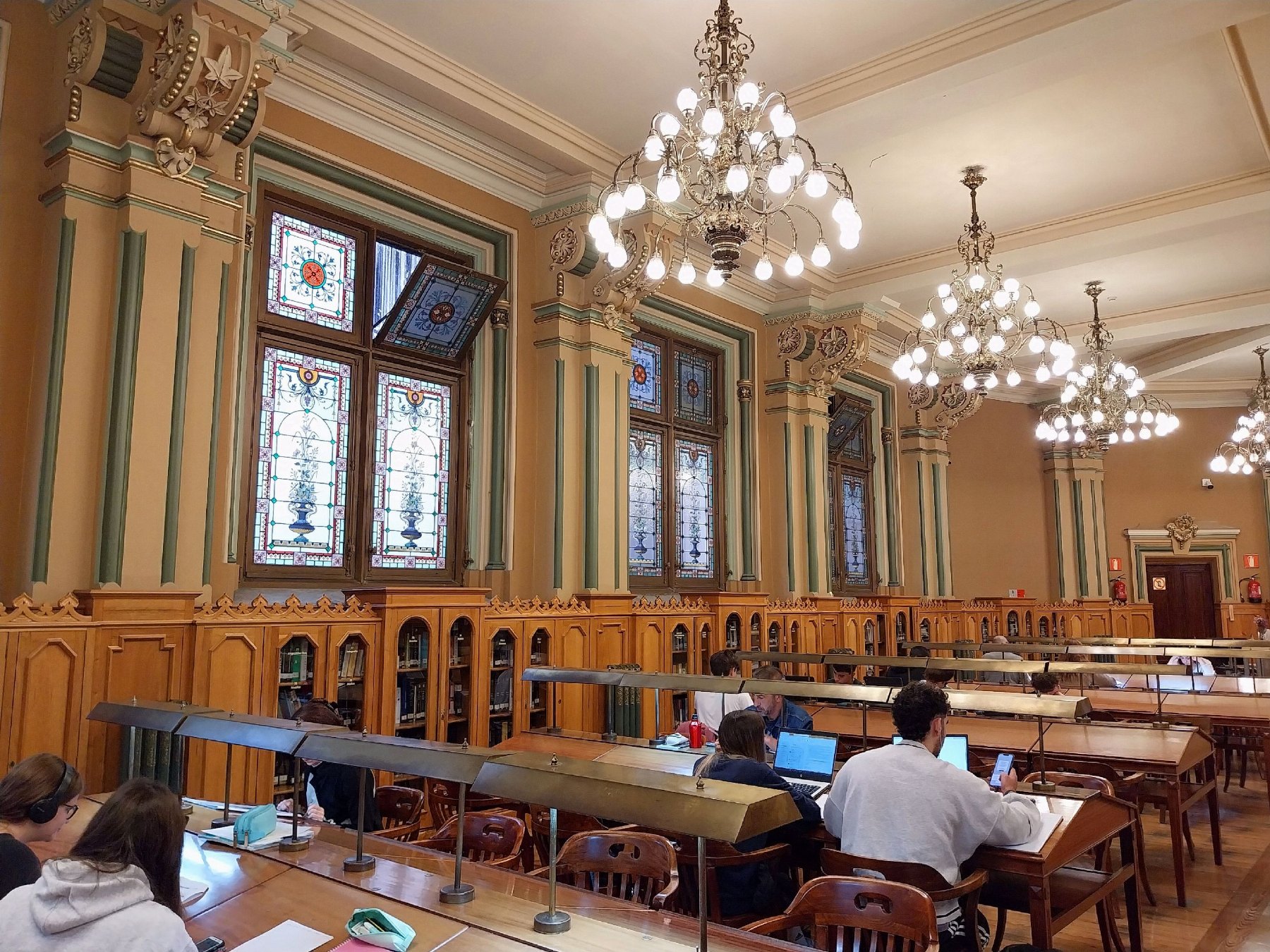
A library is not only a place to sit. With a card you can usually borrow books, films and music, read the press, take part in reading clubs, talks or workshops and, in many centers, use computers. Part of that offer also works from home: eBiblio, the public e-lending platform promoted by the Ministry of Culture with the autonomous communities, lends e-books and audiobooks to anyone with a card from a participating library. Loan limits and periods depend on each regional portal, such as eBiblio Madrid.
Getting a card is usually free and quick, but it is still a step: networks normally ask for an identity document, and some let you start the process online. If you plan to use the library regularly, it is worth doing it on your first visit rather than on the day you need a computer.
Can I work there? Explain what kind of work
Reading documents and writing in silence do not have the same needs as teaching a class, making a video call or holding a meeting. That is why we do not present libraries as free offices for unlimited use.
The Community of Madrid rules reserve its group rooms for collective work, with booking and specific conditions, and exclude the profit-making activities described in those rules. The fact that a room exists does not mean that any meeting is allowed. For a professional activity or a call, ask the center explicitly.
A useful question would be: “I need to write on my laptop for two hours, with no calls. Which room can I use, and are there any conditions?” This avoids asking permission for an activity that is too vague and makes it easier for staff to give a concrete answer.
The building’s opening hours are not always the service’s hours
The official page of the José Hierro Public Library in Usera warns that reading-room use and internet end 15 minutes before closing time. It is a good example of a check that is often left out of quick searches.
If you can only go at the end of the day, those minutes matter. Also look for notices about public holidays, temporary changes and closures. We do not apply this library’s hours to the rest of the network: the example shows what to ask, not a general rule.
Exam season, long days and late hours
Some periods put more pressure on reading rooms than others. In 2026, for example, the Community of Madrid announced that from May 11 to July 3 it would extend the hours of eleven public libraries in the capital for exam season: two of them open 24 hours a day and nine with rooms available until 1 a.m., with 1,234 reading places in total. During the extended hours, access was limited to the adult reading rooms. Check the Community of Madrid’s page on the libraries of the capital for each year’s announcement. Madrid City Council also runs municipal study rooms, some with longer hours during exams.
The lesson goes beyond Madrid: at certain times of year, finding a free seat may depend on arriving early, and extended hours often come with their own conditions about rooms and age. If you need a long session, plan it outside peak weeks or ask about booking options.
Heat, cold and climate shelters
Libraries are also refuges from extreme temperatures. Barcelona’s network of climate shelters, which includes libraries, passed 500 spaces in summer 2026, according to local press. The same summer showed the limits of that role: an indefinite strike by library staff kept most of the city’s libraries closed for weeks. A public space is not only a building with air conditioning; it depends on the people who open it, keep it and look after it.
If you are looking for a cool or warm place, check the official list of shelters in your city and, on the day, whether the center is open. Do not assume that every library on a map is available.
Living together: the rules of the room
Every library publishes its own rules, but there are a few questions that are worth asking yourself before you go: can I eat or drink in this room? Where can I take a phone call? Can I leave my things on a seat while I am away, and for how long? Are there quiet areas and areas for talking? Respecting these rules is what makes the space usable for everyone, especially at busy times.
Many centers also have specific areas for children and families, for young people or for older readers. If you are going with others, choose the room that fits the group rather than adapting the group to the quietest room.
Beyond the library: other places where you do not have to buy anything
Libraries are not the only option. Municipal cultural centers, civic centers, some museums with free entry at certain times, parks, public squares and community facilities can also be places to be without consuming. The same method applies to all of them: describe what you need, check the official conditions and do not confuse “free” with “unconditional”. A museum with free entry may not let you sit and work; a cultural center may have rooms only for booked activities.
A five-question checklist to choose your space
This is our planning tool, based on the comparison above. You can copy it and fill it in before your visit:
- Activity: am I going to read, write, use a computer or meet people? In which room is that allowed?
- Access: do I need a library card, registration, a booking or a phone? Can I sort it out before I arrive?
- Time: when does the service end and how long is each session? Are there notices for that day?
- Specific needs: is the route accessible for me? If I need a power socket or another resource, is it available and allowed?
- Alternative: if there are no places left, which other center can I check? Do I have its access information?
There is no need to turn every outing into an investigation. It is enough not to base the whole plan on a single label, such as “free”, “open” or “with wifi”. If the website does not answer your question, contacting the center can save you a wasted trip.
Public spaces need rules, but also clear information
Defending places where you can be without buying anything does not mean ignoring other people’s needs or turning any room into a space for any activity. It requires knowing what each facility offers and under what conditions. Information about access is part of its usefulness, not a secondary administrative detail.
Our proposal is to assess these places with a more specific question than “is there a library?”: can I use it for what I need, in the time I have and with the resources I have? That is where culture, service design and everyday life meet.
Sources and scope
This article combines our own editorial analysis with the linked official pages of IFLA, Madrid City Council, the Community of Madrid, Valladolid City Council and the Ministry of Culture, and with local press for the Barcelona examples. We have not checked capacity, power sockets, connection speed or route accessibility on site. The conditions belong to the networks cited and may change; they are not extrapolated to all libraries in Spain.
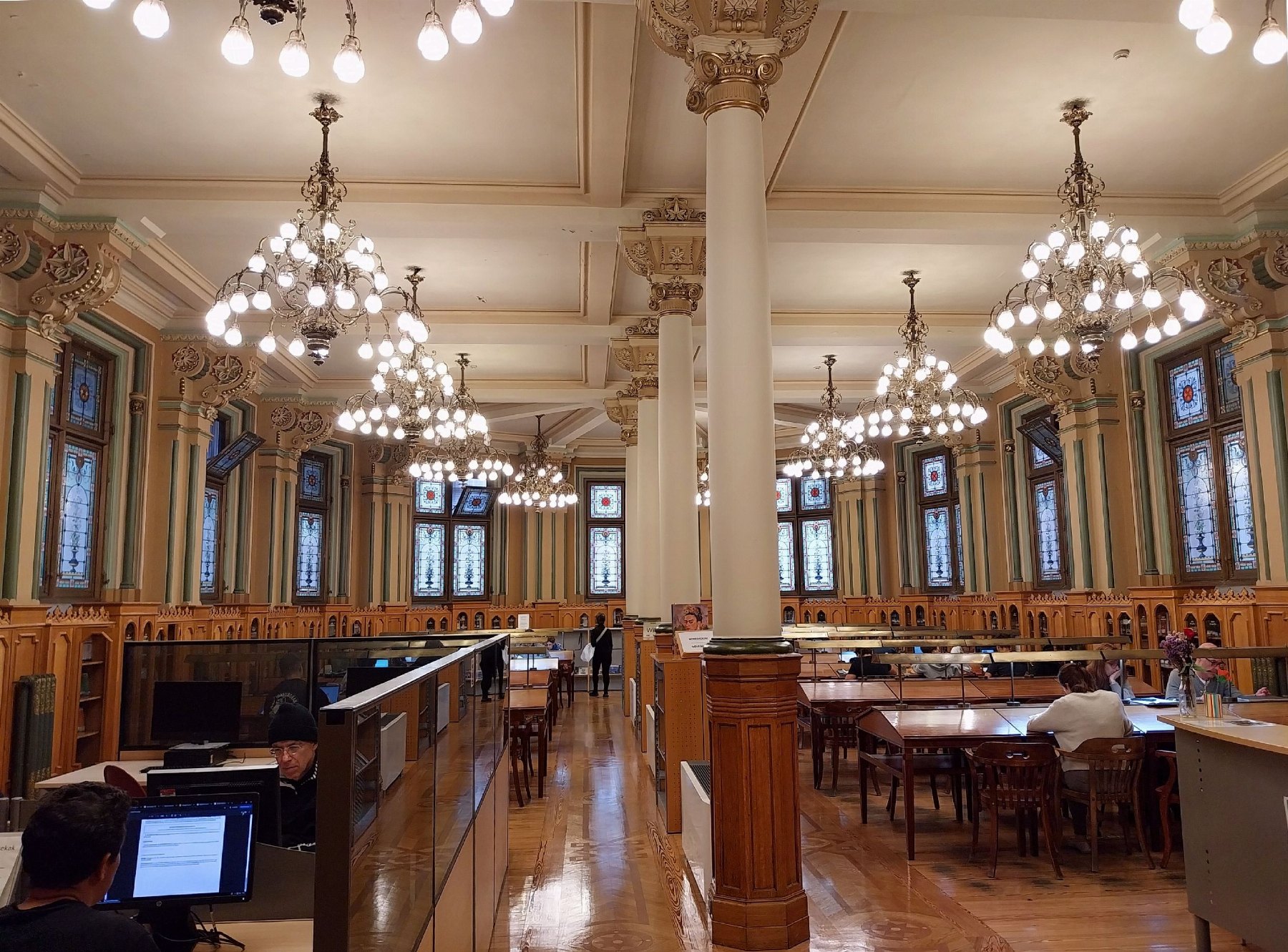
Cover photo: reading room of the Bidebarrieta Municipal Library, Bilbao. Photo: Zarateman, CC0, via Wikimedia Commons.


